

Research & Evidence
The Science Behind Localized Cryotherapy
What decades of peer-reviewed research tell us about the power of cold therapy and what it can do for recovery, performance, and the human body.
You've probably heard of cryotherapy. Maybe you've seen athletes stepping into freezing chambers or celebrities touting cold therapy benefits. But beneath the buzz, there's real science: decades of peer-reviewed research documenting exactly what happens when cold meets the human body.
This page is our attempt to lay it out clearly: what cryotherapy is, how it works, what the evidence actually shows, and what claims you should be skeptical of. We cite our sources, acknowledge limitations, and let you decide.
What is cryotherapy?
Cryotherapy, from the Greek kryos(meaning "icy cold"), is simply the therapeutic use of cold. Ice packs, cold showers, ice baths, and high-tech cryo chambers are all forms of cryotherapy. The idea isn't new: cold has been used medicinally for thousands of years.
The Edwin Smith Papyrus from ancient Egypt (~2500 BCE) describes using cold to treat injuries. Hippocrates recommended cold for swelling and pain. In 1845, English physician James Arnott used salt-ice mixtures to treat tumors and nerve pain.
The modern era of cryotherapy began in 1978, when Japanese rheumatologist Dr. Toshima Yamaguchi built the first whole-body cryogenic chamber. He discovered something important: rapid cooling produced much stronger pain-relief and endorphin effects than slow cooling in an ice bath. That insight, that speed matters, opened the door to modern cryotherapy devices.
~2500 BCE
Ancient Egypt
1845
James Arnott
1978
Dr. Yamaguchi
Today
Localized devices
Types of cold therapy
Not all cold therapy is the same. Different methods work at different temperatures, for different durations, and target different areas of the body.
| Type | Temperature | Duration | Best For |
|---|---|---|---|
| Ice Pack | 0°C (32°F) | 15–20 min | Basic first aid, swelling |
| Ice Bath / Cold Plunge | 5–15°C (41–59°F) | 10–20 min | Full-body recovery |
| Whole-Body Chamber | −110 to −160°C | 2–4 min | Systemic effects (requires facility) |
| Localized Cryotherapy | −78°C source | 30 sec – 4 min | Targeted treatment, portable |
Localized cryotherapy sits in the middle: colder and faster than ice packs, but far more accessible and targeted than whole-body chambers. You can use it on a specific joint, muscle, or area without the infrastructure of a cryo chamber or the commitment of an ice bath.
How localized cryotherapy works
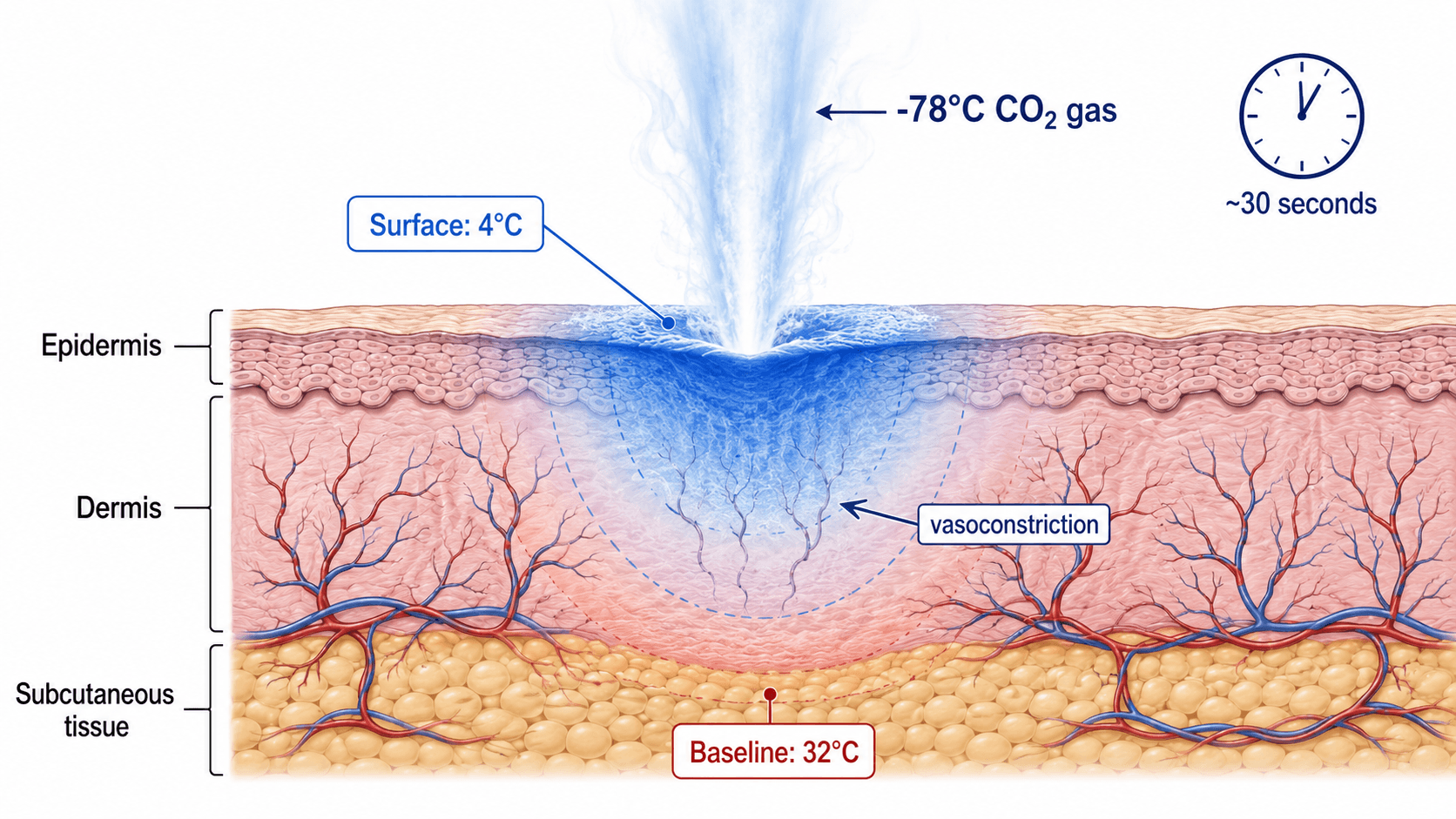
Devices like the CryoGun use pressurized CO₂ that expands through a specialized nozzle, creating a jet of extremely cold gas (around −78°C / −108°F). When applied to skin, three things happen simultaneously:
- 1Rapid cooling: Your skin temperature drops from roughly 32°C to about 4°C in around 30 seconds. This speed is key: the rate of temperature change triggers stronger physiological responses than slow cooling.
- 2Mechanical stimulation: The pressurized stream creates a gentle massage effect, driving cold deeper into tissue than passive ice and stimulating nerve receptors.
- 3Thermal shock:The sudden cold activates your body's response systems, triggering changes in blood flow, nerve signaling, and chemical release that we'll explain next.
What happens in your body
When cold hits your skin, it triggers a cascade of well-documented physiological responses. Here are the four most important:
Pain signals slow down
When skin gets cold, the nerves that carry pain signals literally slow down. A 2007 study in the British Journal of Sports Medicine found that cooling skin to 10°C reduced nerve signaling speed by about 33% and increased pain tolerance by 89%. This is why ice has always been a go-to for acute injuries: it genuinely reduces how much pain you feel.
The "flush" effect
Cold first causes blood vessels to tighten (reducing swelling). Then, as your body warms back up, those vessels open wide, flooding the area with fresh, oxygenated blood. Scientists call this the "hunting response," first documented by Sir Thomas Lewis in 1930. It's why people often feel energized and notice a healthy flush after cold therapy.
Source: Lewis, Heart, 1930
Inflammation goes down
At the cellular level, cold suppresses the inflammatory chemicals your body produces in response to injury or stress. Multiple studies show reductions in markers like IL-6 and TNF-α, the same inflammation markers that doctors measure in blood tests. A 2022 study in rheumatoid arthritis patients found that cryotherapy significantly reduced these markers and allowed 58% of participants to reduce their pain medication.
Sources: Guillot et al., 2017; Klemm et al., Clin Exp Rheumatol, 2022
Natural chemical release
Cold exposure triggers your body to release norepinephrine (linked to focus and alertness) and endorphins (natural painkillers). One study found norepinephrine levels increased by 200–530% during cold exposure. This may explain why many people report feeling more awake, focused, and positive after cold therapy. It's not just placebo; there's a measurable chemical change.
Sources: Šrámek et al., 2000; Leppäluoto et al., 2008
What the research shows
Cryotherapy has been studied extensively in peer-reviewed journals including the New England Journal of Medicine, British Journal of Sports Medicine, and Orthopaedic Surgery. Here's what the research tells us.
31 randomized controlled trials analyzed in 2024 found cryotherapy after knee surgery significantly reduced pain and opioid use.
Liang et al., Orthopaedic Surgery, 2024
Pain relief mechanism
The most direct evidence for how cryotherapy reduces pain comes from nerve conduction studies. When you cool the skin, pain signals literally slow down. A 2007 study in the British Journal of Sports Medicine found that cooling the ankle to 10°C reduced nerve signaling speed by 33% and increased pain tolerance by 89%. This slowing effect persisted even at sites further from the cooling, suggesting a broader analgesic benefit.
Post-surgical recovery
The 2024 Liang meta-analysis of 31 randomized controlled trials found that patients using cryotherapy after total knee replacement had significantly less pain on days 1, 2, and 3. They also needed fewer opioids, had less blood loss, and showed improved range of motion. A separate 2023 study in the Journal of Arthroplasty confirmed significantly less opioid use in the first post-op week.
Sources: Liang et al., Orthopaedic Surgery, 2024; Wyatt et al., J Arthroplasty, 2023
Exercise recovery
A 2026 meta-analysis of 51 randomized controlled trials (1,243 participants) found that local cold therapy produced the greatest reduction in delayed-onset muscle soreness at 48 hours. The same analysis found cryotherapy reduced creatine kinase (a marker of muscle damage) and improved jump performance in the days following intense exercise.
Source: Zhang et al., Frontiers in Sports and Active Living, 2026
Inflammation reduction
Multiple studies show cryotherapy reduces inflammatory markers at the cellular level. A 2022 randomized trial in rheumatoid arthritis patients found that cryotherapy significantly reduced IL-6 and TNF-α levels, with 58% of participants able to reduce their pain medication. A 2025 meta-analysis of 11 trials confirmed these anti-inflammatory effects, particularly in athletes.
Sources: Klemm et al., Clin Exp Rheumatol, 2022; He et al., Scientific Reports, 2025
Joint and tendon conditions
Localized cryotherapy specifically has been studied for common musculoskeletal conditions. A 2015 trial found 10 sessions significantly reduced tennis elbow pain. A 2008 study showed localized cryotherapy improved blood flow in Achilles tendinopathy. For knee osteoarthritis, a 2025 meta-analysis found cryotherapy combined with exercise produced significantly better pain outcomes than exercise alone.
Sources: Kawa & Kowza-Dzwonkowska, 2015; Knobloch et al., Am J Sports Med, 2008; Dias et al., 2025
Migraine relief
Targeted cooling has shown promise for headache relief. A randomized crossover trial applied cold to the carotid arteries in the neck of 55 migraine patients. Those receiving cold treatment saw a 32% reduction in pain within 30 minutes, while the control group actually got worse. The researchers believe cooling the blood supply to the brain may reduce the inflammation and vascular changes that drive migraine pain.
Source: Sprouse-Blum et al., Hawaii J Med Public Health, 2013
Skin and aesthetics
The vasoconstriction-vasodilation cycle improves local blood flow and oxygen delivery to the skin. Cold activates fibroblasts and may stimulate collagen production. Clinically, cold therapy reduces puffiness, tightens pores, and produces the visible "flush" that clients notice immediately after treatment. Studies have also shown benefits for eczema and psoriasis, with reduced itching and improved skin appearance.
Mood and alertness
The "energized" feeling people report after cold therapy isn't imaginary. Cold exposure triggers a surge in norepinephrine, the neurotransmitter linked to focus and mood. One study found a single cold water session increased norepinephrine by 530% and dopamine by 250%. Long-term research showed these effects don't diminish over time. This may explain why cold therapy has been studied as an add-on treatment for depression, with some trials showing significant improvement in mood scores.
Sources: Šrámek et al., Eur J Appl Physiol, 2000; Leppäluoto et al., 2008

Professional Use
Trusted by elite athletes worldwide
Cristiano Ronaldo spent €45,000 to install a cryotherapy chamber in his Madrid home. When he moved to Manchester, the chamber came with him.
The 2011 Dallas Mavericks used cryotherapy throughout their championship playoff run, a recovery edge that helped them outlast younger, deeper teams.
Leicester City FC incorporated cryotherapy during their improbable 2015–16 Premier League title season, helping players recover faster between matches.
Questions from practitioners
What clinic owners, medspa operators, and sports recovery professionals ask before adding cryotherapy to their practice.
We built this page because we believe informed buyers make better decisions. If you have questions about how localized cryotherapy might fit your practice, we're happy to talk through the evidence with you.